Blog Posts

The Wolf of Journalism

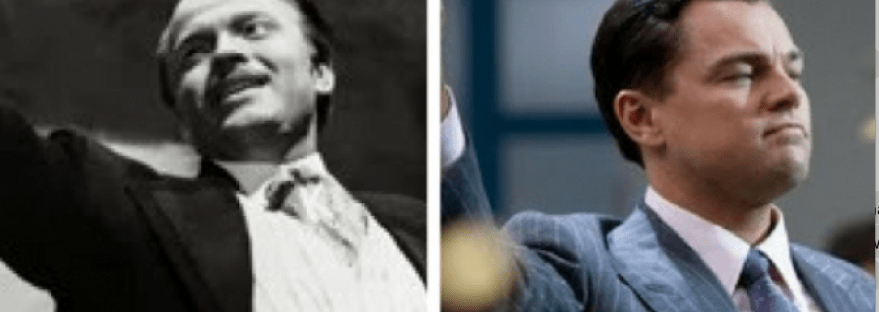
I felt like I was having slight deja vu while watching Citizen Kane for the first time. I now realize it is because the story of Charles Foster Kane reminded me deeply of Jordan Belfort’s character portrayal in the Wolf of Wall Street. Even though the two have strikingly different careers, I couldn’t help but notice they possessed the same spirit, energy, and character flaws as one another. 

One of the greatest similarities I see between Charles Kane and Jordan Belfort is their innocent and well-intentioned beginnings in their prospective industries that eventually got corrupted because of wealth and greed. They both were leaders from the beginning and were able to gain followers and traction very quickly in their careers because people saw a certain quality in them that made them believe in their mission. They were both extremely well loved at the start of their careers, which only helped to accelerate their success since they needed supporters and employees to expand their companies. The especially funny thing is that both of them were able to gain so many followers, yet they weren’t even practicing ethical work tactics from the start. Charles Kane began publishing petty news stories that caught people’s attention, yet didn’t have enough research or merit to be trustworthy news. Jordan Belfort began selling penny stocks in a shady way that encouraged low-income people to purchase thousands of them and lose boatloads of money. They both began their careers through misleading the public, either through catchy headlines or penny stocks.

Eventually, as they became more successful, greed started changing them, or possibly just revealed their true characters. They both neglected their first wives and opted to marry a younger blonde for their second marriages (even though both of their second wives ended up leaving them). The truth of the matter is that the prospect of wanting more and never being satisfied enough to enjoy the things they had led them to lose all of the people closest to them. With Charles Kane firing his best friend after years of not speaking to him and Jordan Belfort ratting out all of the people closest to him for a shorter prison sentence, both men ended up utterly and extremely alone no matter how many riches they possessed. 

Though Charles Kane didn’t technically participate in illegal activities like Jordan Belfort, there is no doubt that his actions were immoral. Especially when it was revealed that he influenced the American public to support the Spanish-American war, even though Mr. Leland firmly believed it was an unnecessary war. Charles Kane was able to live out his full days with his wealth and prestige and got to deeply feel the effects of being alone in an estate to himself, while Jordan Belfort is still on the scene today remaking himself by telling his story. Overall, the ambition and drive of these two men that allowed them to quickly make a name for themselves by inspiring others around them was strikingly similar. The most glaring similarity was how well-loved they were before they lost sight of themselves.

Featured Image

My favorite minor character was Emily Norton, the niece of the President of the United States that was Charles’s first wife. She was played by Ruth Warrick. The reason she is my favorite character was because even though she was the niece of the president, she was very down to earth and was patient with Charles for so long before finally being absolutely disrespected by him. She did not deserve any of that. The scene with her and him sitting at the dinner table, and them growing less attentive to each other was sad.

DIY Projects

SAVE THE TIGERS.

Ever since I learned that tigers are going extinct, I genuinely could not believe that saving the tigers is not being widely talked about and so many people are unaware about this issue. Tigers have always been one of my favorite animals, and they are one of the most revered animals on the planet. Through doing this project, I learned many people believe that tigers should be the real “King of the Jungle” because they have greater size and strength compared to that of a lion. Tigers have been admired, feared, and revered through Indian, Japanese, Chinese, and many other country’s folklore and culture for centuries. In modern day, tigers are found in hundreds of cultures throughout the world, especially in the United States. The U.S. is home to about 5,000 captive tigers, while the number of tigers still in the wild is estimated to be around 3,900. Tigers have somehow been incorporated and exploited in American culture in such a deeply integrated way that we forget that this isn’t their home. Tigers belong in their habitat, but unfortunately, 95% of their historic habitat has been destroyed.

Habitat destruction and poaching are the two biggest factors that contribute to the endangered status of the tiger. Deforestation and the expansion of human activity and civilization have taken away much of tiger’s habitats, which left tigers to be killed by their new neighbors and have no place to hunt. Tiger poaching has become a large problem because of the enormous illegal tiger trade in Asia. Though there are strict laws against poaching in Asia, the demand for these animals has only increased.

I recently watched the documentary “Our Planet” on Netflix, and there was a gorgeous shot of a tiger captured in the Siberian forest. The behind-the-scenes episode explained that the videographer of that tiger had to live alone in the winter forest for more than 3 months just to see one tiger. He had hundreds of cameras that he would check every morning, and it was extremely emotional when he finally got the shot he was looking for. It is extremely depressing that the tiger population is so scarce that we have to cherish this footage he received because there isn’t much like it anymore.

I feel passionately that Americans should know about this issue, and not only be aware of it, but care about it. In order to try and get Americans to care about the issue, I thought it was compelling to include popular tigers found in entertainment, sports, and pop culture. Celebrities love to use tigers as a photo opportunity and/or an accessory, yet they are not advocating for the tigers in their natural habitat. I wanted people to remember their favorite tigers and how integral tigers have become to our culture and feel the urge to advocate for the Big Cat Public Safety Act or possibly make a donation to worldwidlife.org, an organization that is working hard to save the tigers. The Big Cat Act will stop private tiger ownership in the U.S and roadside zoos. This will hopefully discourage the continued illegal tiger trade all the way from Asia.

Sources:

Since I wanted the explanation for why tiger’s were going endangered to have cohesive graphics, I cut clips from this youtube video to explain

https://www.youtube.com/watch?v=SrYWN1aqxmM

https://www.worldwildlife.org/species/tiger

https://www.smithsonianmag.com/science-nature/america-has-tiger-problem-and-no-ones-sure-how-solve-it-180953974/

https://bigcatrescue.org/big-cat-act/

https://www.huffpost.com/entry/if-a-tiger-fought-a-lion_b_3348978

https://www.tigers-world.com

DIY Projects

Most Expensive Game of Poker

IMAGE SOURCE

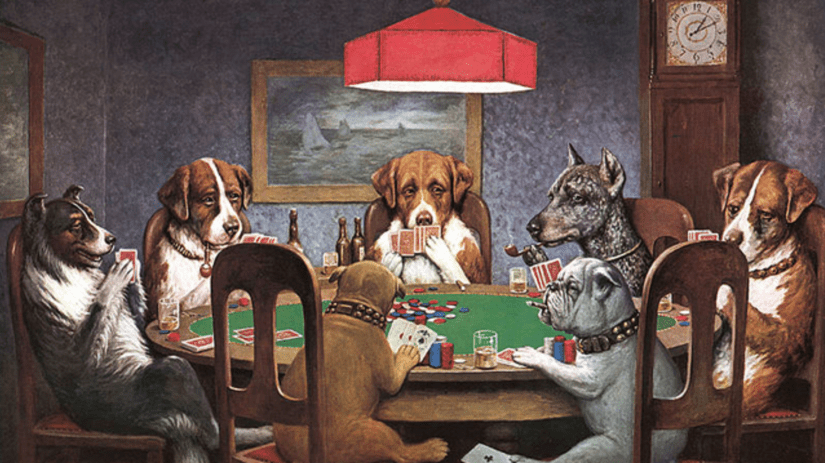
I chose to manipulate the classic Dogs Playing Poker painting by Cassius Marcellus Coolidge. Although the painting is considered an iconic piece of work and has had significant cultural influence, at the time of its release, elite artists did not take the work seriously and it was simply a humorous, satirical piece. The specific and most popular painting I used, A Friend in Need, is a part of a series of 18 paintings that were commissioned for cigar boxes, calendars, and advertisements. Ever since, it’s been in millions of homes, and has a lighthearted reputation. The image also spread because of the humor behind the bulldog in the front cheating by showing his ace to his partner.

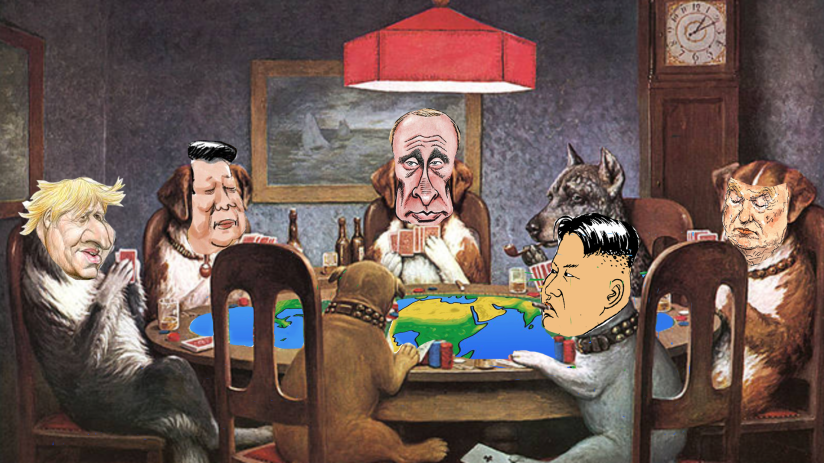
I decided to change the image by putting the faces of Donald Trump, Xi Jingping, Kim Jong Un, Boris Johnson, and Vladimir Putin over the faces of the dogs. I also changed the poker table to a map of the world. By doing this, I was aiming to portray the leaders of today’s biggest countries as simply gambling with the lives of the world’s citizens. It is clear that they are each only playing for their own pleasure and to maximize power for their own respective countries, just like in a game of poker. They are playing to win. Instead of living in a connected, giving world where leaders are making decisions that are in the best interest of the people, these leaders are making decisions that are selfish and economically driven. International politics are characterized by every country strategizing on how they can surpass others, no matter the consequences. The title Dogs Playing Poker can still be used for the manipulated image…

The original images of the leaders can be found at the following links.

Donald Trump

Vladimir Putin

Boris Johnson

Kim John Un

Xi Jingping

The map

Blog Posts

Do you believe anonymous?

In a very passionate article, editor in chief of the Atlantic, Jeffrey Golderg, details some of the most obscure and outrageous claims about President Trump that I have seen to date. Ofcourse, as someone who also dislikes Trump greatly, it’s easy to blindly accept all of Goldberg’s claims and believe his statements as truth. However, as an aspiring journalist, I have to remember one of the most foundational life lessons in this society: Don’t believe everything you see on the internet.

Goldberg’s main claim is that President Trump has no respect for members of the U.S. military and does not understand the concept of sacrifice without personal gain. These claims are extremely sensitive in a country that honors and respects the sacrifices of its military very deeply, and if they were supported by concrete facts, would surely cause many Americans to be personally offended and outraged at the President. The truth is, I expected more out of the editor in chief because the Atlantic has a highly-esteemed reputation as being a reliable news source, but every single account and source that was cited in this article was anonymous.

The second paragraph starts with one of many extravagant claims that President Trump “did not believe it important to honor American war dead,” and his source for this comes from “four people with firsthand knowledge of the discussion that day.” Throughout the remainder of the article, Goldberg references people with firsthand knowledge of the events he references, and many of these sources include very specific quotes that President Trump supposedly said to back-up his claims. If these quotes and anecdotes were confirmed fact, then Goldberg would have very compelling arguments, but because of the fact that every source is 100% anonymous throughout the piece, the claims become less believable as the article continues. 

Goldberg references his sources as “witnesses,” “aides,”general officers,” “three sources with direct knowledge,” etc. He uses the most general terms possible to describe his sources that give him all of the quotes and evidence to support his claims. If you were to theoretically accept all of these sources as trustworthy, they would all have high proximity, low independence (since there is nothing to gain if they are remaining anonymous), and an unknown level of expertise. 

Through his shocking statements and inclusion of never-before-seen quotes from President Trump, Goldberg succeeds at capturing his audience all the way through. He uses a vehemently aggressive and disgusted tone throughout the piece to ignite the same disgust and passion in his readers that dislike Trump, and in hopes that his Trump-supporting readers will rethink their support.

Again, if any of Goldberg’s sources weren’t anonymous, many of the evidence for his arguments would be logically accurate, however, the fact that he leaves out the names of every source, takes away from the credibility of the article as a whole, and many other of his arguments are not logical. For example, the claim that President Trump believes that the military is beholden to him and not the Constitution is supported by the fact that he employed armed troops during the BLM protests. Although I do not agree with this decision, he is not the first president to use the Insurrection Act, and he technically was in his Constitutional right. 

I find it harder to believe that out of the many sources he references, not a single one would feel comfortable sharing their name. Also, assuming that all of these sources actually did have first-hand knowledge of all of the events described, I find it hard to believe that that many people close to the President would be willing to talk to a reporter with specific quotes behind the President’s back. Although, they may truly be motivated through personal dislike towards the President.

Jeffrey Goldberg is a highly awarded, highly experienced journalist, however, he also has been writing extremely anti-Trump articles for many years now. In fact, a majority of his articles for The Atlantic are attacking President Trump. The Atlantic is known to be left-leaning. It’s clear that writing about politics is a very tricky situation because it is hard to separate personal belief from reporting. Golberg’s motivations are clearly to tear down President Trump in any way possible to gain more support for his positions and possibly influence Americans to not re-vote for him. Although there’s no personal gain for him, campaigning his personal beliefs through extremely outlandish claims and opinions is a verified way to get people to actually read his articles and consider his points. 

Featured image source

Blog Posts

THOUGHT CONTROL

Have you ever had a dream about someone that just straight up does not belong in your thoughts or subconscious? You wake up upset and confused, and you just want to know why! This typically happens with people I at least know in real life, however, after tracking my media consumption for 24 hours, I was disturbed with a dream about Addison Rea that night. 

Addison Rea is not only the second most followed account on Tik Tok, but she’s also the cover of every Snapchat article that I have seen for weeks. She is the sole reason that I have not clicked on Snapchat news in as long as I can remember. I did not choose for my news feeds to be dominated by Tik Tok stars, and I certainly did not choose for my thoughts and dreams to be plagued by them either. I genuinely don’t even watch these influencers. It seems that the influencer culture on social media has invaded every aspect of my life.

As much as we all hate to admit it, there comes a time when we have to confront the reality of social media and influencer culture. The reality is that we have more control over what we’re consuming than we think. Through tracking my media consumption, I truly understood how little responsibility I take over my media habits, and as a journalist major, I am deeply disappointed in myself. 

Social media is a leech to my mind and prevents me from making productive use of my time. I clicked on the same apps all day knowing that I would see nothing meaningful or beneficial to my life. Many times, I knew that it hadn’t been long enough, and I most likely would not see any new posts or updates. I take no action to stop myself from re-clicking on the same apps, and seeing the same content on repeat. Everyday is the same cycle.

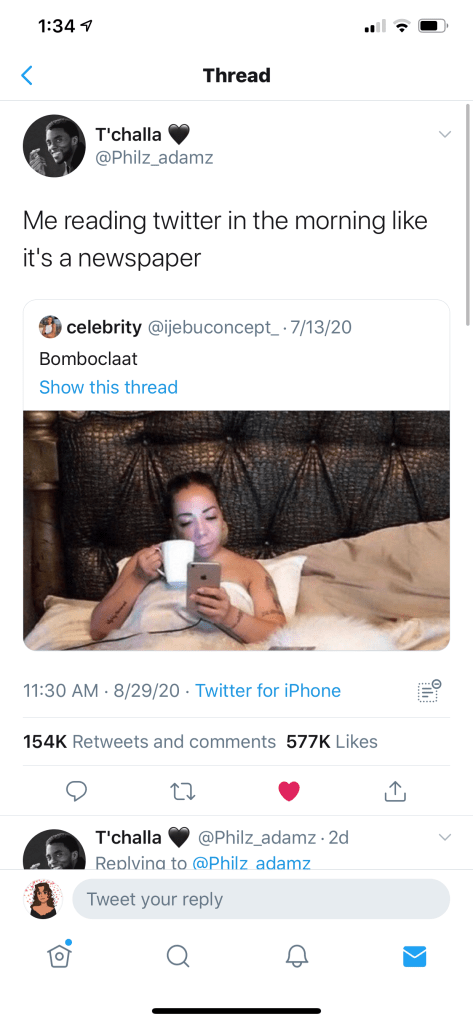
The only app that makes me feel like I am staying up to date with current events and trends is twitter. I saw the tweet above during my day and felt like it described my life so accurately that it was scary. Twitter is one of my only sources of news. I took note throughout my day at the types of news I was seeing on the app, and most of the sources had the same opinions and leaned left. While a lot of these sources coincide with my own beliefs, it doesn’t allow me to expand my thoughts or hear much from the other side, which restricts my ability to be a well-rounded media consumer.

The most compelling discovery I made was that I inherently don’t even enjoy scrolling through my feeds. It would be understandable if my content was a guilty pleasure of mine, however, that simply isn’t the case. I don’t know how I let myself get so addicted, but the first step in overcoming addiction is admitting there is a problem.  

I never want to have a dream about a Tik-Tok star ever again.